 |
Truce between Christians and Saracens.
Matthew Paris, Chronica Maiora, Parker MS 16II, f.139v.
|
-
- Review of God's War by Jonathan Phillips in The Telegraph, September 2006.
- Review of God's War by J.L. Nelson in the London Review of Books, 2007.
- Interview with Christopher Tyerman about his book God's War.
 |
| Urban II preaching at Clermont |
In this interview, Tyerman talks about how it is misleading and ahistorical to draw direct connections between modern wars in the Middle East and the medieval crusading movement. I agree with him on this point, and it brings me to a general matter I forgot to mention in class, which is: while modern parallels and experiences can be useful tools for helping us think about the past, we should never confuse them with historical argument itself, which always has to be based in the evidence and context of the period. I'm sure you knew this - but especially following our discussions about ANZAC cove and Canterbury it seemed a good time to remind ourselves of this point...
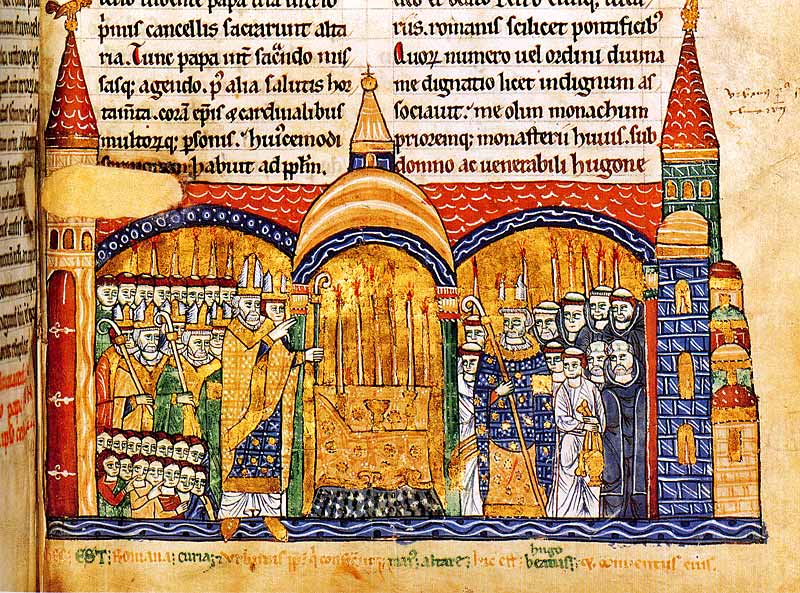 |
| Urban II preaching the crusade |
But back to the Crusades! The Institute for Historical Research in London runs a monthly seminar about the Crusades, so clearly there's no shortage of opinion and debate on the topic.
Post your thoughts and responses to these readings below by Monday evening. Then we'll be moving on to St Francis and Co.!
