Showing posts with label crusades. Show all posts

Wednesday, 2 May 2012

The Crusades and Christian Love

This week’s topic is the idea of Crusading as an Act of love. Pretty much right away the phrase “Crusading as an act of love” doesn’t quite add up. These violent wars do not conjure up ideas of love. But in this week’s readings Jonathan Riley-Smith explains to us how they were viewed as an act of love by Christendom and those who preached for the Crusades. The love of their neighbours, the fellow Christians of Jerusalem and the Byzantine Empire, of Christ, and even of their enemies were all ideas, showing crusading as being an act of christianly love and are espoused by Riley-Smith in the first reading. 

These ideas are not so hard to reconcile with the ideas of the Crusades. As the Crusades show us brave Christians going to the Holy Land to liberate their fellow Christians out of love. Of defending the realm of Christendom out of love, as Cardinal Odo of Chateauroux preached to his audience. “It is a clear sign that a man burns  with love of God and zeal for God when he leaves country, possessions, house, children and wife, going overseas in the service of Jesus Christ” There is no doubt that the Crusades were not only regarded as holy missions, but also as acts of love.

The issue therefore comes when discussing the Fourth Crusade. A topic that is dealt with in the readings of this week, the Fourth Crusade in which the heavily in debt crusaders sacked the Christian city of Zara and then sacked the great capital of the Christian (Eastern Orthodox) Byzantine Empire, Constantinople. This desecration of Constantinople goes against the ideas of Christian love guiding the crusades, of love of their Christian neighbours and the rescuing of the holy land. In this case, they were attacking the very Christian neighbours of the Byzantine Empire that they were meant to be liberating from the Muslim Threat.

As for those who preached the Crusades as being acts of love, such as Pope Innocent III. He was infuriated, ashamed and quick to rebuke the actions of the Crusaders against Constantinople. He was shocked at the actions of them, against those whom he saw as still being Christian. This was not the act of love that he had preached for. However, his reaction was short lived, as eventually, when the Crusaders returned bearing riches and holy treasures as well as the changing of many formerly Eastern Orthodox areas to Western Catholic under the authority of the Pope he quickly rescinded the excommunication of the Crusaders. 
--Jake

[Editor's note: Greg's contribution to follow...]

Wednesday, 18 April 2012

Crusades and Crusade Historians

 [Edit: spelling of Tyerman corrected - thanks to JJ.]
Truce between Christians and Saracens.
Matthew Paris, Chronica Maiora, Parker MS 16II, f.139v.
In lectures during week 7 Clare raised the issue of thinking about where historians are coming from when they write. I'd like us to try and incorporate this into our discussions in this week's virtual tutorial. I've provided some links that give you other people's perspectives on Christopher Tyerman, author of the chapter on the Meaning of the Crusades, and his work. There are reviews of one of his recent books by Jonathan Philips - another well-known historian of the Crusades - and Dame Janet (a.k.a. 'Jinty') Nelson, a prominent early medievalist. I've also given you a link to an interview with Dr Tyerman himself. If you can, I recommend reading through these after you've looked at Tyerman's chapter. Address the questions in the reading pack, but also consider whether Tyerman's view seems to represent a consensus; and how his views differ from or relate to those of others who have written and thought about the Crusades.

In this interview, Tyerman talks about how it is misleading and ahistorical to draw direct connections between modern wars in the Middle East and the medieval crusading movement. I agree with him on this point, and it brings me to a general matter I forgot to mention in class, which is: while modern parallels and experiences can be useful tools for helping us think about the past, we should never confuse them with historical argument itself, which always has to be based in the evidence and context of the period. I'm sure you knew this - but especially following our discussions about ANZAC cove and Canterbury it seemed a good time to remind ourselves of this point...


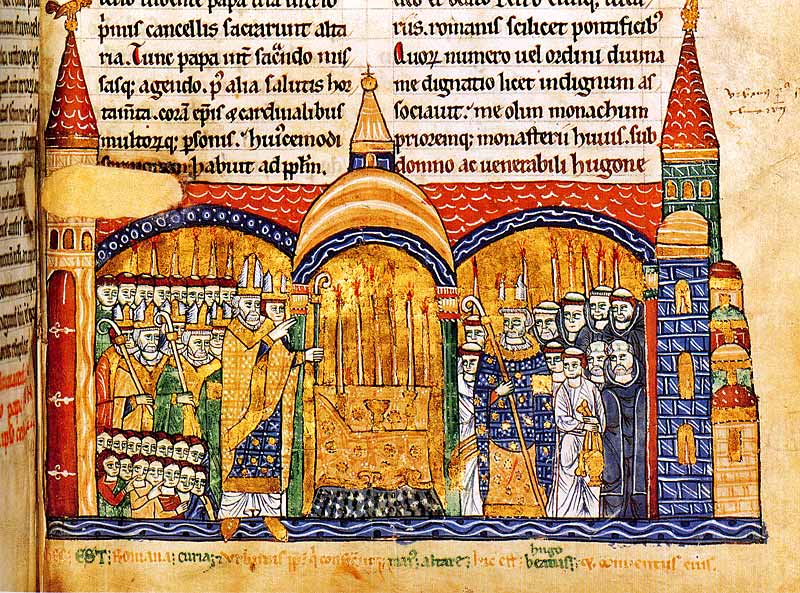
Urban II preaching the crusade

But back to the Crusades! The Institute for Historical Research in London runs a monthly seminar about the Crusades, so clearly there's no shortage of opinion and debate on the topic.

The same was true at the time of the very first crusade. As Megan told us a couple of weeks back, pope Urban's sermon was recorded in different versions by a range of observers. Does applying similar principles of interpretation to these reports help you think about how and why they differ? Where were these medieval writers coming from, do you think? Why were they writing? Who was in their assumed audience?
Post your thoughts and responses to these readings below by Monday evening. Then we'll be moving on to St Francis and Co.!